
SAY WHAT YOU SEE® Handbook—NAPPA Gold Winner!
Who says children don't come with handbooks?
Read our award-winning handbook right now, online for FREE, and tell us what you think.
Winner of two gold awards!
|
Buy the book to get ADDITIONAL supplementary material:
|
BUY NOW: |

Online SAY WHAT YOU SEE® Handbook
I'm delighted you found us! We don't advertise, so please let me know how you found us in the comments below. After you read it and try it, I'd love to hear what you think and how it works for you.
Thanks, Sandy Blackard
Want to learn more?
Take Online Classes. Visit the blog. Get Updates.
"If you’ve ever been confused as a parent or teacher about what to say or how to respond to your child, then this book is for you. It’s short enough to re-read again and again, which is lucky, because you’ll want to." — Dr. Lawrence J. Cohen, author of Playful Parenting
"I just love your approach. It so simply and beautifully sums up what everyone is trying to say about positive discipline." — Tracy Cutchlow, author of Zero to Five: 70 Essential Parenting Tips Based on Science
"Great illustrations and excellent material...interesting and easy to read. I absolutely loved reading this book." — 2012 NAPPA judge, Dr. Stephanie Mihalas, NCSP, founder of The Center for Well-Being
“So concise. There’s more on each page of this little book than in all the other parenting books I’ve ever read.” — Teresa, Parent, Austin, TX
Read the book. Watch videos. Take classes. Visit the blog. Shop SWYS. Receive updates.
76 Comments
I’ve received many inspired comments and SWYS stories by email over the years. Now you can leave me yours right here! I look forward to hearing from you.
I just read your book online (thank you for having it available for free!). It is so helpful. I took notes and will put it into practice right away with my children. Thank you!
Monique
What’ s the title?
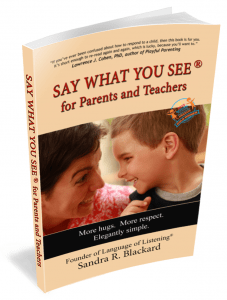
Valentina, on the website I just call it the SAY WHAT YOU SEE® Handbook. The official title as pictured on the paperback above right is: SAY WHAT YOU SEE® for Parents and Teachers. Thank you for asking! — Sandy
I have heard about your link from Pinterest and have found great ideas on parenting and need more that fit my lifestyle without needing to change anything but my interaction with my grandson who is 3 and a handful.
I look forward to your ideas and advice and hope that many are available at no cost to me only as my budget is nil
Sincerely,
dani
Dani,
It’s wonderful to hear from a grandmother! Thank you for your interest and for letting me know how you found us. It’s great to know we are showing up on Pinterest.
Even a strong-willed three-year-old can be a delight to be around when you master the skills I teach for getting on the child’s side to diffuse boundary struggles, offering CAN DOs to help him meet his needs inside your boundaries, and finding STRENGTHs that he can draw on to manage his own behavior with pride.
I hope you like what you find in my online book and in the other free resources on my website. Be sure to check out my blog. There are hundreds of posts to help you find the answers you need.
Warmly,
Sandy
I want to thank you for giving me the chance to read your book, and Thanks also for the wonderful 3 steps to do the right thing. I always try to care for my students ‘ feelings and This technique will be more than helpful in my room.
Blanca,
I’m delighted to hear my three-part coaching model will help you in your classroom. You can change a student’s life by facilitating their feelings. Imagine knowing your teachers care how you feel, not just what you know or it you’ve gotten your work done. I’d love to hear how it goes for you.
Warmly,
Sandy
I was directed to this book by another parent on a Facebook Montessori group. I will read it and then comment with any feedback. Thank you kindly.
Ida, thank you for letting me know how you found my online SWYS book. I look forward to hearing what you think after you read it.
Warmly,
Sandy
I’ve finally found a great philosophy of how to lead my children in a peaceful way. I must work on myself to improve my attitude to my girls because it really works. At this time however I am just at the beginning of this adventurous journey. Thank you for the website and the little book online. It helps me a lot.
Every time I remember to “say what I see” with my son or daughter, unexpected and wonderful things happen in our relationship. Thank you for so clearly explaining a way to be present with children.
Parents, do not let the simplicity of this approach fool you. SWYS is the “how” of unconditional love. This empowered, empowering world view has the capacity to create world peace–one child, famly and one person at a time!
I can’t count how many times I have heard “I wish your mom was MY mom” or “I wish my mom was as cool as yours.”
Being raised with the SWYS method is the best thing that could have ever happened to me. Not only do I love and respect my mom, I love and respect myself! That’s something no one can take away from me, ever. I have always felt powerful and important, and I know that I am capable of anything. Plus, I love spending time with my family–my mother and sister are my best friends, and I love that we are, and always have been, so close.
Betsy,
What a delightful comment to receive on Mother’s Day! I remember asking my mom, “What was your greatest achievement?” She answered, “You kids.” I know exactly how she felt.
Mom
Thank you so much for sending me a copy of “Say What You See” It will be immensely helpful for the parents I am working with and I will be integrating the very practical, doable suggestions into the Filial Therapy I am providing, as well as referring them to your website.
This is a wonderful book, thank you for putting it online for everybody to read!
I really wish that you can reach the goal of 1 million people reading it by next fall.
I’m interested to read this as I have had a training with Garry Landreth. Thanks for the great resource!
This book has come highly recommended from experienced mamas. I’m interested in receiving the Kindle ebook. Thanks!
I very much enjoyed your talk at the API meeting this morning, and read your handbook this evening- it’s fantastic! Thank you so much for sharing. I’m thrilled to have read it when my son is still so young.
Recently, I find myself sometimes going down the wrong path with my 2 1/2 year-old twins…setting rigid rules, getting upset and blaming, and allowing days here and there to pass without feeling the joy of being a very lucky mom. Today, I looked for help and I came across this quick and priceless read and have (again) resolved to become a more mindful parent. It takes a village even if it is a village of support coming through your computer screen one afternoon during naptime!
Sandy,
I can’t thank you enough for the information you’ve shared in this book. Anytime I have a particularly frustrating day with the kids, I just read it again and it lifts me up and gets me back on track. Instead of dreading what the kids will do next, I feel inspired to put SWYS into action again. You’ve made me a much better mom, but I do still slip back into my old ways sometimes. Any ideas on how to prevent this from happening?
Suzanne,
We all slip back sometimes, but never back to the beginning. Once you’ve read the book and it strikes a chord in you, you will always hear yourself when you say or do things the old way that were simply invisible before. That’s a good thing and part of the learning curve. It’s also why do-overs are part of the plan. Do-overs allow you to be human, even to the point of “monster mom” yelling sometimes, as long as you go back later, explain that it wasn’t how you wanted to act, and then say or do what you would’ve done if you had had a clearer head.
Especially for those of us who tend toward perfectionism, do-overs model self-acceptance for our kids – something they need to see. It gives them and us space to relax, knowing we can recognize and correct things that are over the boundary of who we want to be. “Owning” your reactions (not blaming your child for them) during the do-over conversation is crucial. You may not like what your child did, but your reaction came from your perception of the moment which was triggered by something you experienced or learned in the past, i.e. hot button. The proof is your ability to discuss the infraction later in a calm way by saying what you saw and coming up with workable CAN DOs for the next time. When kids learn our reactions are about us not them, they can let our reaction be our problem and focus on correcting their own problem – the behavior. (Read blog post Ending the Blame Game)
To advance your parenting skills even quicker, what you want to check is where “slipping back” happens the most. Look for a pattern. It can be a relief to find it, especially when you discover that you are the parent you want to be most of the time, except for one or two “little” things! Is it the time crunch that gets you? Or maybe one certain type of behavior? Our patterns direct us to our own points of personal growth.
Thank you Sandy, I do tend to be a perfectionist. I think my slipping back happens the most when I’m feeling tired, stressed or upset. If I don’t get a good night’s sleep or I have a lot going on, I can easily turn into monster mom. Thanks for reminding me that we all need do-overs and for showing me how I can turn these episodes into something positive for my kids. I think if I can become more accepting of myself, faults and all, that it will also help me to become more accepting of my children’s less than desirable behavior and to recognize the healthy needs behind all the drama.
Suzanne,
You are right! Recognizing healthy needs is the key. I’ve noticed a lot of perfectionists like me lump emotional calm into the mix of our expectations of self. Learning to accept our naturally wide range of emotions is part of our journey. See that little word you used at the end of your comment – drama? Dead give-away. And of course your kids, or at least one, will pick up on your urgency to control emotions and try to prove to you that extreme emotions are valid. What better way than drama? Remember, children MUST communicate until heard.
So the more you validate their extremes with matching vigor and expression (not sarcasm), the sooner their drama will drop off. It’s taking on an “of course you would feel like that” attitude and really understanding how a broken cookie or a torn paper could be the worst thing ever!
If the child’s blow ups occur mostly at “last straw” moments, the child may have taken on a pattern of trying to control emotions, too. That’s even harder for a child than us, so the stress is even greater. Controlling emotions is not needed; controlling behavior is. Big difference. So finding appropriate ways or places for the child to fully and completely express all emotions is the best path to follow.
One last tip. Play “stressed mom” or “monster mom” with your kids in the peaceful times. Act it out in the extreme and let them be “it” sometimes, too. When they are “it,” be sure to let them choose to be “monster mom” or “monster kid,” and take direction on how they want you to react. Then ham it up! You will get lots of giggles. But the best part is that in acting it out in play, they will see that monster mom, in play or in real time, is just the way you act sometimes, not who you really are. Likewise monster kid. This is an important lesson for all of us in life.
Play acting also prepares you for a bigger step. In real time, when you are feeling stressed and about to blow up, instead of compounding the pressure by adding restraint, go the other way and meet your needs by mimicking your play acting. Start exaggerating your feelings – get purposefully dramatic! The on purpose-ness meets your need for power/control while the exaggerated noises and movements of monster mom validate your emotions. You innately know what you need and your emotions are guiding you, so go with the flow instead of swimming upstream. The laughter will help you and the kids regain perspective and return to SWYS, CAN DOs and STRENGTHs to effectively resolve the situation.
Then, who knows, you might just realize you are already the perfect parent for your children after all!
Sandy,
After reading your post, I had the opportunity to let my 3-year-old daughter do some play acting today. She was playing this game on the iPad called Snuffles. Snuffles is basically an animated dog that repeats whatever you say in a cute chipmunk-like voice. She was saying silly things to it and we were laughing together when Snuffles said it back. Then she started yelling angry things and laughing even harder when Snuffles said it back. Now, under normal circumstances, I probably would have told her it wasn’t very nice to say those things. But since I had just read your post, I kept my mouth shut and was able to appreciate how this game was helping her explore human emotions in a playful way. It was a great a-ha moment for me. Maybe next time I will even join in.
Thanks again for all your words of wisdom. They are helping me greatly!
Suzanne,
Good catch! Far from teaching her it’s OK to yell angry things at people, by allowing her to yell in play, you helped her trade a taboo for a CAN DO. Now when she feels like yelling in anger, you can say, “You need to yell! You can get all that yelling out at Snuffles, then when you are calmer, we can talk about the problem.”
Observing instead of judging allowed you to see her behavior in a new way. Now, based on what you saw, you can go back and and name a STRENGTH – social awareness. When you consider her choice of what to yell at, it shows she knows that yelling at people is not OK and yelling at a game is. At her age, it is enough to say, “You found something that it was OK to yell angry things at!” She will be so proud and glad you noticed.
Congratulations on another SWYS success!
Hey Sandy!
Say what you see is really working for me right now. I’ve watched your online videos and enjoyed them so much, they were a lot of fun and most of all, they kept it simple. I was searching for a simple parenting style because my mind was bogged down with trying to figure out ‘what do I do now?’. Now I know what I can do. The funny thing is, say what you see is so simple, and yet I want to watch even more videos! Even though I already have the tools in my hands, I want to learn more! If you are ever putting up any of your other courses online, I would definitely be a customer. Thanks Sandy!
Sandy, does Say What You See work with adults ?
I understand it works with teens to, but does it truly stop from age 20 on ?
Thank you for your insights.
I’m sorry, I have found the answer in your FAQs. Thank you 🙂
Tama,
From your question about SAY WHAT YOU SEE working with adults, it sounds like you recognize the Universal nature of the Heart Model. Because the three parts are the core steps for connecting with others, creating cooperation, and building confidence, they absolutely apply to all ages and all situations.
The examples in my book are about children, but to apply it to teens or adults, you simply modify what you describe. Toddlers get excited when you notice even little things they are doing, like picking up a crayon, because that is what they are focused on. Older children and adults don’t think about little things like that any more; moves like that have become automatic so it would be a jolt if you brought their attention to them. When you follow the focus of the person you are listening to and point out what is important to them, regardless of their age, you can connect on any level: DOING, SAYING, FEELING and THINKING.
Thanks for reading the book and taking the time to leave a comment! I would love to hear examples of how it is working for you with children, teens or adults.
Thank you so much for this wonderful resource. I am a mama to a darling 17 month old boy and we are on that exciting journey of being/raising a toddler. I am off to buy your book this minute. I have already read Parenting from the Heart by Robin Grille and I feel that your book will be the perfect follow on, or companion piece, for me. I feel excited to have another resource at hand that speaks so much about the kind of parent I hope to be. From Grille’s book, we have been (what we call) ‘naming feelings’, which is in so many words of course ‘say what you see’ and I can’t tell you the success we’ve had with it. After observing me interact with our son, some family members and friends have said ‘what is it that you’re doing here?’. As soon as we ‘name feelings’ with/for him, it’s like the anger or fear or sadness dissipates so quickly, but the joy, happiness and love magnify. I can tell that he feels understood and as a mama, that’s all I hope for between us at this tender age. We are so grateful for researchers like you that make parenting a hopeful and rewarding experience. Thank you!
Mrs_D,
Thank you for taking the time to comment! I am so glad my book is helping you become the parent you want to be. That warms my heart. As you’ve discovered, raising a toddler can be a joyous adventure and easier than most people think when you are able to understand their communications. You mentioned that you have already seen how “SAYing WHAT YOU SEE your child feeling” can dissipate emotions like anger, fear or sadness and magnify others. What’s actually happening is that understanding and acceptance actually elevate any emotion to the next higher level. It’s always one direction, toward joy. I hope to hear more from you as you apply even more of the simple tools in the book.
Thank you so much for your book, Sandra! Say What You See provides such a comfortable way of communication with children. I can see how the kids long to hear these words, how much they love them. You’ve put difficult things in simple words, in a way that is so easy to remember and that’s why – so powerful. Now I’m reading the book again with my pencil and it feels as though I’m reading it for the first time. It’s so interesting to see all the things that I missed.
Your book is a very special gift to me. Surprisingly short, simple and nice looking :). I loved your pictures! Sending you much love in return. Julia and Masha (4 y.o.) from Moscow, Russia
Julia,
It’s so heartwarming to hear that you found it valuable and comfortable. Children do long to hear those words from us, and it sounds like you are putting them to good use in building a loving relationship with Masha. It means so much to me that you shared your experience of the book with me…all the way from Russia!
I just read through your booklet. Is there a forum where I can ask specific questions? Seems like whenever I try a new approach to parenting, I have a million questions. Right now I am wondering specifically how to get my kids to do their schoolwork without me nagging. I have been trying the “say what you see” approach today and my girls said, “why are you so calm and why do you keep telling us what our emotions are? Did you read a book? What’s the book called?” Ha-ha! It is definitely something I am not use to but I like it. It will take a great deal of practice as I am instinctively someone who asks questions to get results.
Laura,
Thank you so much for taking the time to comment. I’m laughing with you about your girls’ responses.
I answer questions asked in comments and on the blog pages whenever I can. You mentioned that this approach is new to you, and that practice and questions are what work for you, so I hope you will consider my Online Training Center – currently only $19.95 for permanent access. There are over 2 hrs of workshop videos presented in ~5-min snippets, a Q&A page, a mini-ecourse to carry you through, and more. It may be the kind of support you are looking for. And for more personal support, I offer a 1/2 hr free coaching call. Many parents are amazed at what we can accomplish during that time.
Now back to your question: How to get kids to do their schoolwork without nagging. One of the things about Language of Listening that you may like is that it shifts the problem-solving to the child where it belongs, and moves you into a support role and out of the role of “getting kids to do things.” From your children’s responses to you I am guessing they are at least elementary school age, so the shift you desire may be a bit more challenging than if they were in preschool. If they have come to depend on you for motivation, your primary goals will be to reconnect them with their own self-motivation and help them discover what works for them in terms of self-management. Kids learn best from success, so STRENGTHs are the key. You can see what I mean in this post. It’s about working with perfectionist children, but applies to all: https://languageoflistening.com/blog/how-to-correct-a-perfectionist-child
To start the shift, you need to: 1) announce the shift, and 2) clarify what your children want since wanting something is the true source of self-motivation. This sample dialog may help you get started:
SWYS: “Girls, I have an announcement to make. You don’t like me nagging you about your schoolwork, and I don’t like it either. I finally realized why I do that – I forget that you actually want to get your work done, turn in assignments on time, and do well on tests.”
STRENGTH: “I know you do, because I’ve seen how proud you are of your work when it is done well and turned in on time. You like that about yourselves, and here I am treating you like you don’t care about doing well.”
Boundary: “That stops now! So our challenge is how to turn your deadlines over to you in a way that you will succeed.”
STRENGTH: “Since you hate my nagging, you probably want to manage yourselves and deep down inside, you know you can.”
CAN DO: “Must be something we can do make that happen in a way that works for us all.”
Then brainstorm some solutions, try them out, modify them if they don’t work, and try again. The main thing is to get everybody on the same team, which you do by finding your highest mutual goal – in this case your girls succeeding in self-management.
CAN DOs could include:
– making a list together of what skills they need to succeed
– letting the girls design their own time-management systems (reminders, calendar, check-sheets, timers, etc.)
– finding out how they want you to help
Helping your girls get what they want puts you on their side without nagging.
Thank you for your comment and question. I’ll add this to the Q&A in the Online Training Center so even more readers can benefit. I hope to hear from you again.
Thank you for this thoughtful, succinct book and for making it available for everyone to read!
I would like to read your book on my computer. It said to comment on where I found you. I found you from Hands Free Mama website. So beautiful how God gives you information right when needed the most. My 9 year old son and I just had a big fight over him not helping and his anger. I lost my temper as well. Rachel had a post on Facebook about this exact problem which then led me to your site. Thank you!
Tiff
Tiffany,
The book is up now! I hope you find it useful.
I apologize for my late response. I wasn’t getting notified of comments until just now. Thank you for your interest and for letting me know how you found me. So glad you found Rachel’s Hands Free Mama blog! I’ve been helping her respond to readers’ comments for a number of years. She always has something moving to say in her posts.
I know it’s been a while since you asked, but when you did you were seeking information that would help you stay calm and help your son with his anger. I hope you found what you were looking for in my blog.
The secret is in the first step of SAY WHAT YOU SEE®. When a child is arguing with you about not wanting to help (or other things), the best way to stay calm and diffuse his anger is to make his case for him. No kidding! When kids know you understand, they stop fighting. Voice what they want and use the all purpose CAN DO to turn the problem-solving back over to them.
For example start with:
SWYS: “You don’t want to help me. You have things you want to do yourself.”
Add more details about exactly what he wants and why it’s important to him until he starts nodding. That’s when you know you’ve connected. Then say what he wants and state your boundary with an AND so he knows both are important.
For example:
CAN DO: “Sounds like you want to go to your friend’s before you help, so you have plenty of time with him, AND this needs to be done in the next 15 minutes. Hmm. Must be something you can do to have as much time as possible with your friend…”
Let him solve it, or if he is blank, offer suggestions to get him going like:
CAN DO: “You could do it in fast motion.”
Or if you have time, bring more connection to the task by offering to help get him going with Rachel’s question: “How can I help?” If you offer, just be clear about what your boundaries on what help is OK with you. When you treat his goal as important and help him reach it, you will be amazed at the cooperation you will see.
Then you can name that STRENGTH so he can draw on it in the future. For example:
STRENGTH: “You just needed a little help getting going, then you really took off and finished in no time at all! That shows you are efficient, and thoughtful since you said your friend is waiting on you.”
A child who sees himself as thoughtful and efficient will find it easier to help next time you ask, than one who sees himself as selfish or as a procrastinator. Get it? Supporting kids in what they want, inside your boundary changes everything.
You can find the basics of coaching kids like this in the online handbook. When you get the chance to read it, I hope you will let me know what you think, and share it with your friends. And this time, when you leave me a comment, I should be able to reply in a more timely manner.
Warmly,
Sandy
Hi Sandy,
Thank you for all of your research, hard work, and generosity in sharing what you have learned. I came across your website through Lauren’s article “How to Handle Back Talk and Disrespect Like a Parenting Ninja” from The Military Wife and Mom blog. I would love to read your book “Say What You See”, however I keep seeing a warning that says: “So sorry! Technical trouble. Come back soon to read the book free right here!” Can you add me to the email list so I can be informed when the book is available again? Thank you!
Sincerely,
Sarah
Sarah,
The book is back up now! The flipping book plugin we were using went obsolete, and it took longer than expected to get the new format completed. It’s even better though since it is mobile-ready! I hope that helps.
Thank you for the wonderful acknowledgment of my efforts. It’s my life’s work. Great to know it helps others.
I’m so glad you found Lauren’s website. She’s now one of our Language of Listening® coaches. Her posts are wonderfully down to earth and full of resources.
Warmly,
Sandy
I found this link through Rachel Stafford’s blog post today (3/10/17) … I thought this might be a great resource for a teacher friend of mine as well as for me, and I just volunteer with children.
Bonnie,
The book is up now! Thank you for your interest and for letting me know how you found me. Rachel’s Hands Free Mama blog is great! I’ve been helping her respond to readers’ comments for a number of years.
When you get the chance to read the online handbook, please share it with your teacher friend and other friends. I hope you will find it useful in your volunteer efforts since it’s all about making these important skills practical. Please leave me a comment to tell me if it helps. And this time, I should be able to reply in a more timely manner.
Warmly,
Sandy
I found your website through the leftbrainbuddha website. I have 6 kids between the ages of 1 and 8. I would love to be calmer and respond better to my kids. Please let me know when the book will be available again online, I would love to read it!
Avigail,
The book is back up and working better than before.
Thank you for letting me know how you found me. I’m glad to hear we are being talked about on a mindfulness website.
When you get the chance to read the online handbook, I hope you will let me know what you find useful. Calm with 6 children can be a big challenge, but much easier to achieve when you learn the three simple coaching skills I teach. Since my comment notifications are working again, too, I should be able to reply in a more timely manner.
Warmly,
Sandy
Hi Sandy,
Will the Say What You See Handbook be up on the website soon? I would like to share this resource with my school community when it is.
Thank you
Sarah,
It’s up now! Thank you for your patience and for thinking of sharing it with your school community! I’m excited about all the families that could have access to these important coaching skills through your efforts. The thought warms my heart!
Warmly,
Sandy
Site says to check back when book might be available. I am eager to learn how respond to my children more mindfully and hoping the book becomes available soon. I’m a stay at home mom with my third on the way and always looking for way become a more meaningful mom who is able respond well to the kiddos.
Very interested in learning more about this system of response to kids and hoping the book becomes available very soon!
Josephine,
It’s up and ready to read now! Even though it’s a short read, the book will tell you how to respond in a way that helps you get on your child’s side to diffuse boundary struggles, offer CAN DOs that help kids meet their needs, and find STRENGTHs that they can draw on to manage their own behavior. I hope you like what you find in my book and the other resources on my website. Parenting is the most meaningful work I can think of. Your children will benefit every time you use even one of our three Language of Listening® coaching skills! Thanks for taking the time to let me know you are interested in reading my handbook!
Warmly,
Sandy
This looks like a great resource. I found the site by following links from Tracy Cutchlow.
We have a lovely 3 year old boy who is starting to “test the boundaries” and I would like to learn some effective strategies to deal with those situations.
Andrew,
So good to hear from a dad! The handbook is up now! It took longer than expected, but it’s back and better than ever in it’s new mobile-ready format!
Thank you for letting me know you found me via Tracy Cutchlow. She is one of our Language of Listening® coaches. I am so glad you had a chance to visit her Zero to Five blog. Her writing style is immediate and very refreshing.
Three is certainly a great age to learn how to be effective at getting on your son’s side to diffuse boundary struggles, offer CAN DOs that will help him meet their needs, and find STRENGTHs that he can draw on to manage his own behavior. I hope you like what you find in my book and other resources on my website and Tracy’s. These simple skills make parenting way more enjoyable!
When you get the chance to read my online handbook, I hope you will share it with your friends.
Warmly,
Sandy
I found your information from a blog on pinterest and I would love to be able to read the book online for free. I have ano almost 3 year old and a 6 month old. Things are mostly good, but I’m always looking to improve my parenting. I would like to please be notified when the book is back online. In the meantime I will try out the methods based on the reading I’ve done so far.
Thanks in advance
Danielle,
The handbook is back up and can be read free online now!
Two toddlers will keep you busy! The best way to know if you are on track with your parenting is to check with yourself to see if you are enjoying your children. That you would say “things are mostly good” suggests you are. It’s the best measure I know.
I hope the simple coaching skills you will find in my handbook and in my blog and other resources on my website help you enjoy them even more. They have for me and thousands of parents around the world I’ve heard from since I first posted the handbook in 2007.
I hope you will let me know if it helps you when you have a chance to read it and try it out.
Warmly,
Sandy
Hi. I’m looking forward to being notified when your book becomes available again. I have 2 very strong willed boys and trouble keeping consistent limits. The oldest has sensory processing difficulties and I am looking for ways to positively orient him that respect his sensory needs without becoming permissive. The youngest just wants to emulate his brother and suddenly I feel very out of control and not at all like the positive parent I would like to be. I found out about you from the blog Miltitary wife and mom.
Cathy,
Thank you for asking and letting me know how you found me. The book is back up and better than ever since it is now mobile-responsive!
I am so glad you found Lauren Tamm’s site. She is one of our Language of Listening® coaches and often addresses topics very relevant to raising strong-willed children. Her posts like this one on chores [ http://www.themilitarywifeandmom.com/printable-chore-cards-kids-responsibility ] demonstrate how to get on their side with CAN DOs that are inside your boundary, and guide them to their STRENGTHs, which is way more productive and pleasant than trying to control their behavior. Controlling kids’ behavior is their job. Ours is to be clear and solid on our boundaries, help them find ways to cooperate that also meet their needs, and point out their STRENGTHs so they can draw on them next time.
To help you be clear on your boundaries (and help you understand why yours might be so hard to hold), you can read this post I wrote on Boundary Trouble [ https://www.languageoflistening.com/boundary-trouble ]. The links in it will take you to several other related posts.
But there is no better way to get quick specific answers to your particular situation than by sending me a video of how it usually goes, or setting up a private call with me. Either way, we can get right to the heart of the problem and find solutions you will like. Learn more here: [ https://www.languageoflistening.com/classes/classes/#private ]
Warmly,
Sandy
Lauren, the blogger behind The Military Wife and Mom
Kinsey,
Thank you for letting me know how you found us. Lauren is one of our Language of Listening® coaches. So glad you found her blog. She’s so practical!
Warmly,
Sandy
Wow! You amazed me with the number of requests for the online handbook while it was down! There were about 45 more that I discovered this week and responded to by email yesterday.
Both the online handbook and comments are back and working again. My comment notification system apparently went down at the same time that the old flipping book plugin went obsolete earlier this year. Some of you posted several times to be sure I saw your note. Thank you for that. You know what that shows, right? Commitment and perseverance! Those very STRENGTHs will help you put into action the skills you will learn in my handbook.
In your comments, many of you also shared how you found my handbook. Thank you for that. It’s great to find out who is talking about us and helping us spread the word about these simple coaching skills!
A big thank you to the referral sources you mentioned. They each have valuable content of their own to share with parents, teachers, and anyone working or living with children, so I am doubly honored that they would refer you to my handbook.
A BIG thank you to:
-My colleague Rachel Macy Stafford of Hands Free Mama [ https://www.handsfreemama.com ]
-My colleague Dr. Laura Markham of Aha! Parenting [ http://www.ahaparenting.com ]
-Our wonderful Language of Listening® coaches:
Tracy Cutchlow of Zero to Five [ http://www.zerotofive.net ]
Lauren Tamm of The Military Wife and Mom [ http://www.themilitarywifeandmom.com ]
Zuzana Macková of Mothering.cz [ http://www.mothering.cz ]
-The Montessori community, someone on Pinterest, and a number of other wonderful people whom I didn’t know knew about us.
We’re all in this together, so thank you for your commitment to loving, raising, and enjoying the next generation of our children. The simple coaching skills in my handbook will help you help them stay in touch with their inner greatness and grow up knowing anything is possible. I look forward to your comments here after you read it and try it for yourself.
Warmly,
Sandy
Learnt about you from The Military Wife and Mom 🙂
Rebecca, thanks for taking a moment to let me know. Lauren’s blog is great. She’s one of our new coaches: https://www.languageoflistening.com/about/instructors/#lauren So glad you found her and us!
Warmly,
Sandy
I FOUND YOU THROUGH THE MILITARY MOM’S WEBSITE. I GOOGLED “RAISING SONS TO BE GOOD HUSBANDS” AND SOMEHOW CLICKED ON HER SITE TO READ WHAT SHE HAD WRITTEN ABOUT IT. I THEN PROCEEDED TO SEE HER BACKGROUND AND SAW THAT SHE WAS A LANGUAGE OF LISTENING PARENT COACH. THIS INTERESTED ME AS I AM A MOM OF 3 (2 BOYS AND 1 GIRL), I LOVE LANGUAGE AND COMMUNICATION AND I AM RAISING PRETTY DECENT, RESPECTFUL, RESPONSIBLE (ENOUGH), SELF-SUFFICIENT KIDS. THE OLDEST IS 8, THEN 6 AND THE YOUNGEST IS 4. I WAS CURIOUS TO KNOW MORE AND SEE HOW MAYBE THIS WOULD BE A START TO HELPING OTHER PARENTS…
Dianne,
Thank you for letting me know you read Lauren’s blog. I can hear the warmth and pride in your description of your children. You love language and communication, so you are probably very aware of how you speak to them and would naturally be drawn to Language of Listening® to help you take that further.
I hope my book gives you the additional insights and tools you are seeking. I would love to hear your thoughts about what you find when you’ve read the book. If you fall in love with my simple coaching model and find yourself sharing it with other parents, be sure to look into my Coaches Training. Next group starts Jan 2020.
Warmly,
Sandy
I was linked here through the Military Wife and Mom’s website because I was searching for ways to help preschoolers learn emotional coping skills and stumbled upon the phrase “show me the hard part”, which I now thoroughly love! I currently use a whole brain approach to parenting and am very excited to learn what else I can add to my knowledge base with this handbook. Thanks!
Sarah,
So glad you followed Lauren’s link from the Military Wife and Mom blog and stumbled onto that phrase, “Show me the hard part.” It was in my post: “Uh-oh! I think my arm needs a diaper!” It’s my extension of the show-me approach I learned from Dr. Landreth and the world of play therapy. It’s the most powerful phrase I know for helping a child re-engage with a challenging task, and you went right to it!
When you get a chance to read my handbook, I’d love to hear your thoughts on the other how-to’s and tips you find there. Lauren is doing a wonderful job of making them available to thousands more parents and professionals as one of our licensees. Thanks for letting me know what drew you here.
Warmly,
Sandy
Found this article via https://themilitarywifeandmom.com/respond-when-child-feels-rejected/
Kelly,
Thank you for letting me know how you found us. Lauren Tamm’s blog is full of great tips for using Language of Listening® with children since she became one of our licensees. That post makes some very important points. So glad you found her, too. Feel free to let me know your thoughts after you have read my book.
Warmly,
Sandy
Thank you for this! I came across Lauren Tamm’s blog one evening after a particularly trying day with our three year old son. I was in tears because I had suddenly become the parent I never wanted to be, the one who loses it and finds herself yelling or using raised voices with our child. He responds to the intensity of the raised voice, but I never wanted it to come to that. I felt heartbroken that suddenly it seemed like my child lost his manners and no longer felt the need to listen to any adult in his life. He is very strong willed and has tons of energy, so at times he finds it difficult to concentrate on what adults are expecting from him. I learned that I need to use short phrases and ways to curb temper tantrums on Mrs. Tamm’s blog. I also realized after reading your book that a good bit of his behavior is actually driven by the fact he does not feel understood and validated. I am going to make every day a chance to SWYS and build our connection back. He has trouble verbally communicating, speech delayed with speech impediment making his words sometimes difficult or impossible to understand, and we have used sign language to help curb frustration on both sides…I don’t know why I never thought to tie in the fact that he is communicating with his actions and behaviors and I need to learn those too! Sign language relies on more than just hand shapes or finger spelling. It uses actions, body motion and facial movements too as a way to help convey the whole message to the other person. Thank you for open my eyes up and helping me to start on this journey with our family to help our son feel that his communication is being understood.
Lillie,
I’m so glad you found Lauren’s blog and my book. Thank you so much for taking the time to share your breakthrough with me and the other readers here! Woo-hoo! You’ve discovered the power of our first premise, put it into action, and it has already begun to change your life.
It’s so crazy how the answer can be right in front of our noses in our child’s behavior and frustration with us, and we still can’t see it until something finally clicks. Then all of a sudden, everything they do makes total sense, and we get it. As you so clearly explained, we can understand their deliberate actions (signing), but understanding their natural actions (behavior) is the secret to connecting and knowing what to do next to help bring out their greatness.
I’m so happy this important piece has clicked into place for you! That was my exact intention in posting my book online. I am tickled down to my toes that you have found it and made such good use of it! Thank you, thank you for letting me know. I can’t stop smiling at the thought of your child feeling fully heard because you now know how to fully listen!
Warmly,
Sandy
I am new to the child care profession and was unfortunately thrown into the mix without a lot of experience with children to go off of, but ever since I heard of this method via the Military Wife and Mom blog, I have been working to implement it in the classroom. I’ve only just started, but I can see it’s already having a tremendous effect. I have a couple of troubled children who are dealing with a lot in their home life, so I really find these skills to be a godsend. Thank you for all you do, and God bless.
Dani,
I’m so glad Lauren Tamm’s blog inspired you to find out more. And what a testament to your commitment to make a real difference in children’s lives! You can help troubled children turn their lives around by simply understanding and pointing out their STRENGTHs. So glad you are there for them!
If you are interested in earning clock hours for more Language of Listening® training, be sure to check out my online Basic Coaching Skills Course: https://www.languageoflistening.com/classes/online-training-registration
Warmly,
Sandy
Hello Sandy,
Is the free online handbook the entire paperback or part there of?
Lou,
Thank you for asking. The online version that you can read free by clicking READ NOW above is the complete text of the original award-winning book.
The paperback, Kindle Edition, and iBookstore versions include ADDITIONAL supplementary material that readers find extremely helpful, particularly:
– Three Basic Needs tool for finding children’s STRENGTHs
– Heart Model and Premises page
– List of STRENGTHs
The Three Basic Needs section is a preview from my next book, How Kids Work, due out sometime next year.
When you read the online book, please let me know what you think and share it with your friends. I’d also love to hear how you found us.
Warmly,
Sandy
Thank you for your response Sandy, I first heard about your book from a friend (who is a child art/play therapist) quite a while ago. She said she wished she could give every parent and teacher a copy. It’s literally been on my ‘to read list’ since then but I hadn’t gotten around to it.
I was reading a blog Post about picky eaters by Rachel Norman and was curious about her being a Language of Listening® parenting coach. When I looked up the website, it felt like a sign as I instantly recognized the book title. I’m really loving it. It’s exactly what I needed to be reminded of at the moment and definitely need a paperback copy on my shelf to refer back to.
Thank you again.
Lou,
You just made my day!
Wonderful to hear that you and your friend love it. I wish I could give a copy to every parent and teacher, too, so the online version is my way of doing that. You can tell her that she’s welcome to refer clients to read it right here. But nothing beats having your own copy right on your shelf. Thank you for the purchase!
I’m so glad you found Rachel’s blog, too, A Mother Far from Home. All of our authorized coaches provide excellent training for parents, each in their own style. I’m happy to hear hers speaks to you.
Thank you!
Sandy
I’m so grateful to have stumbled upon this incredibly valuable resource that I came across scrolling through pintrest, I believe I followed a link from “The Military Wife & Mom”.
Sandy, I’ll definitely comment again once I’ve read the book and begin to put it into action, however I just had to thank you for being so kind & caring as to make this book available for free to ensure that everyone who desperately needs to learn a better way, has the opertunity to do so. I sincerely thankyou Sandy.