

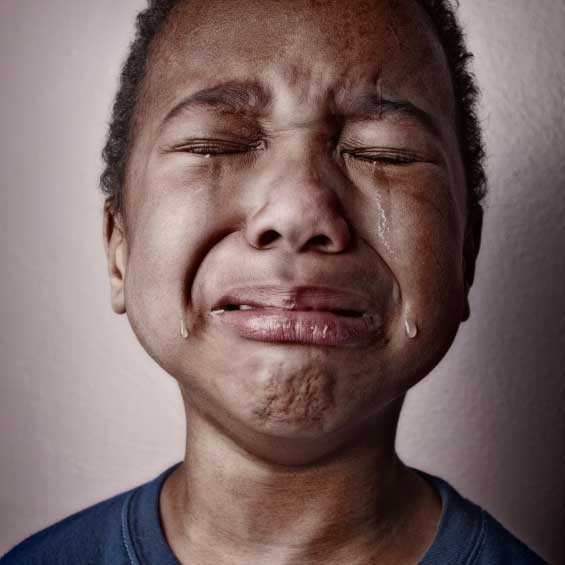
When you hear a child crying, what is your first reaction?
If you know the child, you might have an impulse to rush to their aid and fix the problem for them ASAP. If you can’t do that, you may feel the need to do something to at least distract them or cheer them up.
If you follow our blog or have taken our classes, you have probably heard about our technique for facilitating tantrums. In a nutshell, it involves first allowing the child to completely express their feelings in a safe manner within your boundaries, and then following up with Success Training, wherein you reinforce that the child knew exactly what they needed to feel better and that it worked. Success!
The same basic premise applies to children who are crying from sadness. Often, when a child cries, adults immediately try to figure out what they can do to cheer them up or at least get them to stop crying as quickly as possible.
It makes sense.
Crying is one of the few ways infants have of indicating that something is wrong. It is a signal to the caretaker that something needs fixing, and when the problem is fixed, the crying usually stops shortly thereafter. We are biologically wired to find crying distressing, so we react with urgency to keep children safe!
But as children grow, the purpose of crying broadens. Crying is a natural coping mechanism; it is our brain’s (and body’s) way of releasing tension and sorrow and adapting to things we don’t like. (The Science Behind Sobbing)
You’ve probably experienced the catharsis that comes after a nice, long cry. Sometimes people even intentionally seek out sad books or movies because they “just need a good cry.”
The same is true for kids!
Crying is how kids handle disappointment, frustration, fear, and many other emotions. Stepping in to stop it cuts this process short and inadvertently teaches kids suppression.
What I do instead is respect the child’s emotional expression. Much like facilitating a tantrum, I allow the child to experience their feelings and express them in a way that fits within my boundaries (no breaking things, no hurting self or others, etc.).
As I described it to one parent while holding their sobbing toddler in my arms, “I see my job as that of offering support, not fixing a problem for them.”
Crying is not a problem; it helps the child adapt.
When we step in to prevent or fix every problem our children encounter (including tears, if we see those as a problem), we are sending the message that we don’t have faith in their ability to handle it themselves.
I’m not saying that you should never help your child or offer emotional comfort. What I’m talking about is the knee-jerk reaction to tears that results in a desperate attempt to do whatever is necessary to end them, including things you swore you’d never do.
If hearing your child cry sends you into an instant panic, you might want to stop and look at why it freaks you out so much.
When I examined my own stressed-out reaction to the tears of any child in my care, I found that it was rooted in a family belief that you should always be happy. In theory, this is a great life philosophy. Unfortunately, the flip side is that if you’re unhappy, something must be wrong.
As a kid, this translated into the simplified collapse of “not happy = wrong.” Therefore, I had two choices in life: be happy or be wrong. I don’t like to be wrong, so that left me with only one choice.
Luckily, a few years ago, I realized I had the two collapsed, and I was able to see that they were actually different. Once you have distinguished two concepts as separate, they start to appear that way in your life.
Then, when working at a preschool and a child started to cry after their parents had left, I didn’t panic. I simply used our SAY WHAT YOU SEE® method to facilitate their tears.
I still use the same method today.
It sounds something like this:
Child: (crying)
SWYS: “You’re upset. You didn’t want your parents to leave, and they did. You wish they would stay here, and that I would leave!”
Child: (nods, crying still)
SWYS: “You’re sad that your parents are gone…”
STRENGTH: “…Crying helps. You know exactly what you need to do to help yourself feel better.”
You can usually tell from body language whether or not the child wants physical comfort. If I can’t tell, I just make a statement like, “If you need a hug, I’m right here,” or I offer my hand and watch for their reaction.
Sometimes the child wants to be alone. If that’s the case and the child is old enough to be left on their own, I let them know where I will be or what I will be doing, and tell them that they can come get me whenever they are ready.
When the child finishes crying and starts playing, I do more Success Training:
SWYS: “You cried for as long as you needed, and now you’re ready to play!”
STRENGTH: “You know just what to do to comfort yourself.”
The result
Allowing children to express their sorrow in a safe environment teaches them that their natural reaction (crying) is healthy and acceptable. Being there to help your child feel their feelings teaches them that they can handle upsets and disappointments on their own.
Support without fixing empowers them for the future.
Imagine a world where everyone feels safe to express their emotions instead of ashamed or worried. Together, we can make it a reality in just one generation!
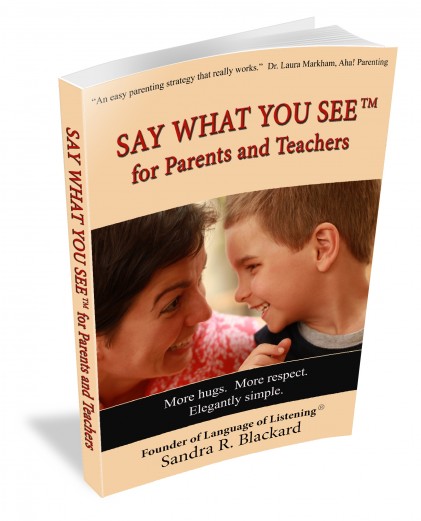
Note: If you’d like to learn how to SAY WHAT YOU SEE®, you can read our little handbook for free on our website, or buy your own copy.
Our intention is to share with the world our eye-opening concepts that lead you from traditional listening to a deeper kind of listening that starts with your eyes and ends with your heart.




5 thoughts on “Why I Let Kids Cry”
This is so interesting! I’m pretty sure I read somewhere that crying is a way for the body to release and clear out the stress hormone cortisol, so letting them release their emotions with your loving presence seems to be the best way to calm down and de-stress. Great post!
This is so great, Betsy!
I know to not panic when someone ( young or old!) starts crying, but I hadn’t thought about the success training aspect. Beautiful!
How do you keep the child within your boundaries? My son (almost 5) will try and do hurtful things in his crying stage, and of course discipline at that point just makes things worse and escalates.
Delphine,
Doing hurtful things is a child’s way to meet his need for power. That doesn’t mean it’s OK, but it tells you the crying you are seeing is not just sadness, it’s a tantrum.
During a tantrum, stopping him from hurting anything or anybody (including himself) will have to be an adult’s job until he learns he can stop himself. The sample video from the Online Training Center at the bottom of the information page gives you great tips on how to use success training to teach kids that they can stop themselves: https://www.languageoflistening.com/classes/online-training-registration/
What Betsy is describing in this post is sadness which may or may not be part of a tantrum. If it is part of a tantrum, the sadness usually signifies a move toward acceptance of the boundary. As Betsy says, the child’s expression of sorrow should not be rushed.
As you’ve seen, tantrums are not all one level. Kids go from anger to sadness and back again depending on the child’s need for power and what we do about it. That’s why you correctly noted that discipline just makes things worse. It has to, because that increases the child’s need for power.
By contrast, facilitating a tantrum keeps the child moving forward through the tears toward resolution and self-calming. You can find out how in my post “Tantrum Relief” here: https://languageoflistening.com/blog/tantrum-relief/
Thank you so much for asking this question. I know it will help many other parents and children as well!
dear betsy and sandy and eva,
i loved the article on letting the tears flow – i recently discovered aletha solter’s work and i love her philosophy around crying which is exactly the same as yours! how i wish i had known this when my children were little – anyway it is never too late – i have been using the success training principle ever since i read SWYS – thanks again – i wish you well! lots of love n prayers, seema
Comments are closed.