
“Again, again!”
You’re in the park with your two children watching the water trickle along a small stream. Your toddler’s eyes gleam as you take his hands and jump him over it. “Again, again!” he cries, completely delighted with his success.
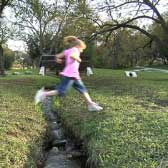
Meanwhile, your 5-year-old daughter sees a wider place downstream, backs way up to take a running leap, and…
Where do they learn that? Children seem to innately know that backing up builds up steam. The bigger the challenge, the further they back up. And they only run forward when they think they can succeed.
Kids are wired for success.
So there she goes, up, over, and plunk. Into the mud — muddy shoes, muddy knees, muddy hands. She looks up at you and starts to cry. What do you say?
A cautious parent who thinks the child shouldn’t have tried in the first place might say:
“Now look what you‘ve done. You’re a mess. You should’ve known better.”
A get-back-on-your-horse parent who thinks the child might give up might say:
“Stop crying. You’re not hurt. Wipe the mud off your hands and try again. Go on; you can do it.”
The missing element in both of these responses is what the child thinks.
If the child thinks they can, and you say they can’t, they are likely to rebel with a reckless, “I’ll show you!”
Or if they think they can’t, and you make them try, they are likely to show you with a, “See, I can’t either!” kind of feeble attempt. They have to because children must communicate what they think and feel until they are heard.
That’s why following the child’s lead and SAYing WHAT YOU SEE is always the right choice.
It’s easy to do when you understand our Running Leap tool.
Think about what kids do when we are not around. They try to wipe off the mud on their own (evidenced by muddy shirts and pant legs), cry until they are done, and then start looking for something to do to make themselves feel better.
Making oneself feel better is the first step in building up steam for the next try.
What if you knew that even crying is the child’s way of beginning to build up steam for the next Running Leap? If you did, it would be much easier to SAY WHAT YOU SEE® like:
SWYS: “You’re crying. You really wanted to do that. You backed way up and tried really hard, then plop. Right in the mud. You didn’t like that at all. You were surprised at first, then disappointed. Now you’re sooo sad.”
Child: “I can’t do it!”
SWYS: “You really wanted to jump that part of the stream, and it didn’t work. That’s so frustrating! You wish you could just sail right over it, then off you’d go to do it again, and again!”
Even a helpless-sounding, “I can’t do it,” won’t ruffle you, as long as you know that tears and verbalizing fears are important ways to release frustration. The freedom to say, “I can’t do it,” allows kids to try again.
Children innately know this. They all do it. Release is the first step in recharging for the next attempt.
So, there it is. From the very moment of incomplete success without any prodding from you, children begin ‘backing up’ to build up steam. SAY WHAT YOU SEE merely speeds them on their way.
When the crying subsides…
The next thing children often do is replay thoughts of the jump going right. Saying what the child wishes as above helps them along.
Visualizing success as wishes is an older child’s version of “Again, again!” that adds more steam.
Children also replay past successes in thoughts, stories, or actions; switch to another task or game they are good at; or take smaller challenges they know they can master — again and again.
This is not backing away; it’s the child setting exactly the right level of challenge for success by backing up.
Again, children innately know that success is the best ‘steam’ of all. The greater the challenge, the more steam they need, so the farther they back up.
When children experience enough success, they raise the bar on their own and run forward to take the leap.
Knowing this, you can be confident your daughter is on the right track.
When you are coming from a place of confidence, you can dry her eyes, SAY WHAT YOU SEE, and watch with anticipation for what she will do next.
And there it is — the first step back.
She goes over to the trickle and tries to show her little brother how it’s done. By showing him how to back up to build up steam, she is doing it herself. Again and again, she’s recharging her confidence.
When we follow their lead, children naturally combine the two approaches of caution and ‘get back on the horse’ at a pace that is right for them. They increase the speed themselves when you SAY WHAT YOU SEE:
SWYS: “You’re jumping over that part of the stream; showing your little brother how it’s done.”
STRENGTH: “You know backing up and taking a running leap sends you further. Look at you go! You jumped it again and again landing solidly on your feet.”
Child: “But this one’s easy.”
SWYS: “Sounds like you’re comparing this jump to the big one. You’re wishing the big one would be easy like this one.”
Child: “Yea. The big one has muddy sides.”
STRENGTH: “So you already figured out the problem.”
Child: “Next time, I think I need to run faster and jump farther.
CAN DO: “That’s an idea. You can test it out over here where it’s drier.”
Once children begin thinking of ways to make something work, it’s just a matter of time until they try again. SAY WHAT YOU SEE, adding STRENGTHs, and offering CAN DOs propels them forward.
Then before you know it, whether it’s this visit to the park or the next, you can count on them returning to the big leap without any prodding at all. They have to. They’re wired for success.
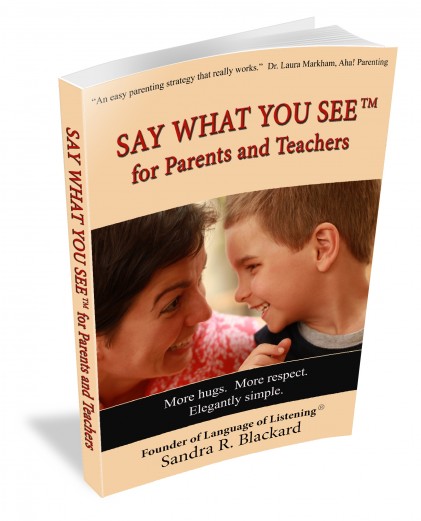
Note: Our little SAY WHAT YOU SEE® handbook can be read free on my website. My intention is to share with the world our eye-opening concepts like these that lead you from traditional listening to a deeper kind of listening that starts with your eyes and ends with your heart.
SAY WHAT YOU SEE is a simple, down-to-earth approach that changes every moment with a child into a rewarding one. By reading the handbook and passing it on to others with children in their lives, you are helping us change the world for all children, one family at a time.